Kann man sich in der CLIL-Welt verlieren? (Teil 1)

Eine nahezu philosophische Frage … ja, man kann. Die Basisliteratur dazu scheint geschrieben und veröffentlicht zu sein, neueste Entwicklungstendenzen werden meist auf internationalen Konferenzen und in in Foren vorgestellt. Den Überblick zu bewahren ist schwierig, zu vielfältig sind auch die Varianten und Einsatzmöglichkeiten von CLIL, auch der Begriff CLIL selbst ist nicht allzu eindeutig definiert. Einen guten Ein- und Überblick zu grundlegender, aber auch aktueller Literatur bietet die „Leseliste“ auf den CLIL-Seiten (CLIL-> CLIL Training -> Eigenfortbildung) des CEBS, die auch eine Hilfestellung bei der Grundausstattung einer CLIL-Bibliothek am eigenen Schulstandort sein soll.

Oder anders gefragt: Could you get lost in the world of CLIL?

Oh yes, you could for sure. Watching videos is always good, reading books is sometimes even better. What about listening CLIL? Patrick de Boer from The Netherlands has recently started his series of podcasts always worth visiting and watching out (or listening in) for news, promised.

If you were really keen on getting lost, I´d recommend Kent Anderson´s eleven Pools Projects started in 2002 and constantly expanded since then. It´s hard to say where to start exploring this invaluable rich pack of resources, you might want to treat yourself to some of their 61 free and ready to use CLIL scenarios for vocational schools and colleges. All the scenarios have been made based on a set template with PowerPoint presentation and lesson plan. The scenarios (with list of aims and objectives) describe how to plan and teach in a CLIL based module, i.e. a subject module from the chosen vocations, which is taught through a foreign (or second) language. Want to learn more? Go to the scenarios.

For more information, get in touch with your online CLILvoc coach, please.

Leistet CLIL einen Beitrag zur Förderung von Beschäftigungsfähigkeit und aktiver Bürger/innenschaft? (Teil 2)

Ja, beide Begriffe (aus der Lissabon-Strategie der EU, März 2000) werden im CLIL-Leitfaden für HTLs als Zielsetzungen von CLIL genannt.

Ziele dieses pädagogischen Konzeptes sind unter anderem größere Flexibilität und Gewandtheit von Schülerinnen und Schülern im Umgang mit Fremdsprachen, die Förderung der Beschäftigungsfähigkeit (employability) sowie eine Vorwegnahme unterschiedlicher Aspekte der beruflichen Realität in einem zunehmend globalisierten Arbeitsmarkt (active citizenship). (CLIL-Leitfaden für die Umsetzung an HTLs, Oktober 2020, S. 2.)

Wissen auch die Schüler/innen um diese Zielsetzungen? Das sollten sie, denn … „Wenn man weiß, was man tut, kann man tun, was man weiß.“ (Hans Ulrich Bänziger, Schweizer Psychologe und Schriftsteller, zitiert nach: gutezitate.com/zitat/206650)

Oder anders gefragt: Do students know that CLIL is meant to foster their employability?

Well, probably not at first glance, if you don´t tell them. Talk to your students, tell them why you´re going to deliver lessons the CLIL way, tell them what the rules of the game are and how they´re going to benefit from it all. The CLILSTORE PRACTITIONER GUIDEBOOK, authored by the members of the CLIL Open Online Learning project, has some useful arguments for this discussion in class ready too. Just go for it … and tell me, if you want/need more support here.

For more information, get in touch with your online CLILvoc coach, please.
Leistet CLIL einen Beitrag zur Förderung von Beschäftigungsfähigkeit und aktiver Bürger/innenschaft? (Teil 1)

Ja, beide Begriffe (aus der Lissabon-Strategie der EU, März 2000) werden im CLIL-Leitfaden für HTLs als Zielsetzungen von CLIL genannt.

Ziele dieses pädagogischen Konzeptes sind unter anderem größere Flexibilität und Gewandtheit von Schülerinnen und Schülern im Umgang mit Fremdsprachen, die Förderung der Beschäftigungsfähigkeit (employability) sowie eine Vorwegnahme unterschiedlicher Aspekte der beruflichen Realität in einem zunehmend globalisierten Arbeitsmarkt (active citizenship). (CLIL-Leitfaden für die Umsetzung an HTLs, Oktober 2020, S. 2.)

Oder anders gefragt: Does CLIL promote employability and active citizenship?

In the abstract to their conference paper of 2017, Martina Gaisch et al. describe CLIL as a true driver for enhanced graduate employability.

Due to increasing international cooperation between enterprises, a profound understanding of intercultural aspects has become a major driver for labour market developments, especially in cross-border regions. Consequently, higher education institutions have to prepare future graduates for global citizenship and cultural literacy. Not only do they need to educate students to be proficient in their subject areas, they also have to keep a critical eye on graduate employability. The need for a richer skill base may go beyond technical expertise and also embrace factors such as foreign language skills, intercultural competencies, conflict management and communicative effectiveness.

Martina Gaisch, Victoria Rammer, Lenka Hrušková, Jana Krátká, Gabriela Mádlová (2017): Content language integrated learning as a driver for enhanced graduate employability. A cross-cultural study between Austria and the Czech Republic. University of Applied Sciences Upper Austria, Vysoká škola technická a ekonomická v Českých Budějovicích.

Makes sense, doesn´t it? Tell me, if you want to learn more about this.

For more information, get in touch with your online CLILvoc coach, please.

Sollen auch CLIL-Lehrer/innen und ihre Schulleiter/innen zusammenarbeiten?

Eine oft gestellte Frage. Die Antwort: Ja, unbedingt. Die Schulleiter/innen zählen zu den Key-players, wenn es um die Umsetzung innovativer Unterrichtskonzepte geht. Die Schulleiter/innen sollten mit den Ideen und Zielsetzungen genauso vertraut sein wie die CLIL-Lehrer/innen selbst … um zu unterstützen, um zu motivieren und, falls nötig, organisatorische Hürden aus dem Weg zu räumen. Idealerweise sind die Schulleiter/innen selbst auch CLIL-Lehrer/innen, wenn nicht, sind CLIL Crash- oder Schnupperkurse auch für Schulleiter/innen sehr empfehlenswert.

Oder anders gefragt: Should principals join the CLIL teams too?

Yes, of course. In my last blog post I mentioned the regular INSETTs at my own college. Same here. The principal, the heads of the informatics and electronics departments on board as well? For sure, most appreciated and powerful engines for team spirit and group dynamics.

Are you a principal, or a department head? Do you want to learn more? Have a look into Peeter Mehisto´s Excellence in Bilingual Education: A Guide for School Principals, published by Cambridge University Press in partnership with Cambridge Assessment International Education (2012) or watch Peeter Mehisto talking in an interview based on certain chapters of his book. You´ll like it.

For more information, get in touch with your online CLILvoc coach, please.

Sollen CLIL-Lehrer/innen zusammenarbeiten? (Teil 2)

Ja, das sollten sie, von der Zusammenarbeit können schließlich alle profitieren. Erfahrungsaustausch, Vorbereiten von Lesson Plans, und gemeinsames Auftreten als CLIL Team stärken den inneren Zusammenhalt einerseits und die Position der Gruppe nach außen andererseits. Ohenhin werden Lehrer/innen allzu oft mit ihren Sorgen und Ängsten, aber auch mit ihren Erfolgen völlig allein gelassen. The CLIL Team kann zu einer „Marke“ innerhalb der Schule werden, ein sichtbares Zeichen für einen Gruppe von Unterrichenden, die sich jenen Zielsetzungen, die im CLIL-Leitfaden für HTLs und der CLIL-Handreichung für HLFS angeführt werden, verschrieben haben.

Oder anders gefragt: Could SCHILFs help to develop this CLIL team spirit?

When we started regular CLIL-INSETTs (SCHILs, as we´d call them here) at my own college decades ago, we weren´t quite sure what the possible outcomes of these sit-togethers of colleagues, who thought of themselves as being The CLIL Team, might be. Teacher development, i.e. language and grammar work (on demand), materials development and micro-teaching and didactics have been on the program regularly since then with colleagues bringing their drafted teaching and study materials to the meetings and expecting feedback and guidance both in terms of content and language.

On-site testing, evaluation and improvement in a safe and trusted environment is actually what these colleagues come for. And some of them even stay for an after-work drink in the nearby restaurant then.

Tell me, if you want to learn more about the CLIL team spirit and how to get there.

For more information, get in touch with your online CLILvoc coach, please.

Sollen CLIL-Lehrer/innen zusammenarbeiten? (Teil 1)

Ja, idealerweise tun sie das auch. Kooperation und Austausch stärken den CLIL Team Spirit. Und dieser CLIL Team Spirit ist eine unverzichtbare Komponente, um CLIL an der Schule zu einer erfolgversprechenden Story of Success zu machen.

Oder anders gefragt: As a CLIL teacher, you´ll never walk alone, right?

Well, some of us do (or have to) but … it´s good if you´re in touch with others, if you can let off steam, complain about the extra workload with (almost) no extra time and money given, about too much red tape and the need to leave a routine-led comfort zone. CLIL teams can be like social events to bond with colleagues who have often been working in the same college building for ages, not aware of who is who and who does what. CLIL is what makes them connect … improving our students’ language skills, preparing them for job lives in a globalized economy and fostering employability and active citizenship is what makes these CLIL people succeed.

Tell me, if you want to learn more about the CLIL team spirit.

For more information, get in touch with your online CLILvoc coach, please.

Wird CLIL beurteilt? (Teil 2)

Wie im letzten Beitrag erwähnt, wird in Österreich CLIL als solches nicht beurteilt. Die Lehrer/innen werden aber ihren Schülerinnen und Schülern auch im CLIL-Unterricht regelmäßig Feedback geben, wie in allen anderen Unterrrichtsgegenständen auch. Mária Babocká stellt in ihrem Beitrag zu CLIL in Foreign Language Education (Constantine the Philosopher University in Nitra, 2015) ein relativ unkompliziertes Modell für Self-, Peer- und Teacher Assessment vor, das sich auch gut dazu eignet, Feedback zu geben.

https://www.researchgate.net/figure/Example-of-Comparative-Self-Assessment-Sheet-for-CLIL-Classes-adapted-from_fig3_338718980/download (01/11/2022)

Oder anders gefragt: If we don´t assess CLIL as such, do we assess the L (for language) and the C (for content) separately?

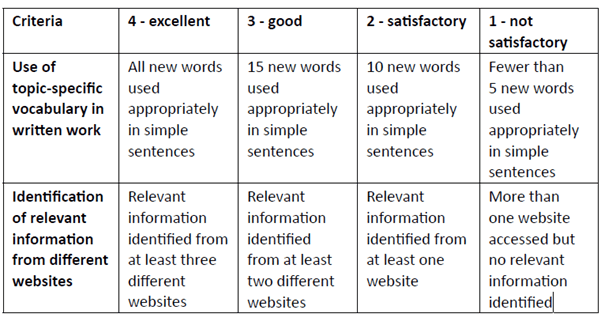
We do assess the content, of course, as in any other subject. You´ll have your own assessment criteria for this at hand, I´m sure. However, the use of topic vocabulary and the competence of identifying relevant information might also be included. This is why in terms of content The CLIL Guidebook by Clil4U (p. 44, past version not available anymore) suggests the following assessment grid:

Does this make sense? Tell me what you think.

For more information, get in touch with your online CLILvoc coach, please.

Wird CLIL beurteilt? (Teil 1)

Gute Frage, aber … da CLIL kein Unterrichtsgegenstand ist, kann CLIL selbst auch nicht beurteilt werden. In einigen europäischen Ländern beurteilen die CLIL-Lehrer/innen jene Fertigkeiten, die im CLIL-Unterricht besonders gefordert und gefördert werden, als zusätzliche Komponente zur Beurteilung im Fach, d.h. sie lassen diese CLIL-spezifischen Komponenten in die Gesamtbeurteilung im Fach miteinfließen. Viele österreichischen Lehrer/innen sind jedoch der Meinung, dass zumindest die Beurteilung der sprachlichen Fertigkeiten ihrer Schüler/innen „the language teachers´ business“ ist (und bleiben soll).

In Österreich gilt:

„Für die Leistungsfeststellung und -beurteilung sind nur die fachlichen Kenntnisse der Schülerin/des Schülers im jeweiligen Unterrichtsgegenstand, nicht jedoch ihr/sein sprachliches Ausdrucksvermögen in der Fremdsprache heranzuziehen.“ (CLIL-Leitfaden für die Umsetzung an HTLs, Oktober 2020, S. 12, bzw. Handreichung zur Umsetzung von CLIL an Höheren land- und forstwirtschaftlichen Schulen, März 2018, S. 13.)

Oder anders gefragt: What about assessment in CLIL?

A number of people wanted to have this question answered by the panelists on the last day of Patrick de Boer´s Online CLIL Summit 2022. Some of the participants thought that we should focus on the development of our students´ oral communication skills and their critical thinking and thus avoid the stress and pressure of test and exam situations. Most Austrian CLIL teachers fully agree with this, I´m sure. No assessment of CLIL, no specific assessment of the language being used in these lessons… this is what I´d call a risk-free zone, something I´ve actually talked about couple of times before. The risk-free zone, appreciated by both students and teachers, i.e. room to move without being watched/supervised/evaluated constantly.

Others though are convinced that CLIL must be assessed, in any case. If not, it´s not worth the effort. No assessment, no good? What do you think?

Let me know if you want to learn more about assessment in CLIL. A truly exciting topic that is.

For more information, get in touch with your online CLILvoc coach, please.

Kann der Wissenserwerb im CLIL-Unterricht gemessen werden?

Während in nahezu unzähligen Studien die positiven Auswirkungen von CLIL-Unterricht auf den Spracherwerb nachgewiesen werden konnten, liegen zum Wissenserwerb (Knowledge Acquisition) im CLIL-Unterricht nur wenige gesicherte Erkenntnisse vor. Badertscher und Bieri konnten in ihrer Studie (Wissenserwerb im Content and Language Integrated Learning. Bern, Stuttart & Wien: Haupt, 2009.) nachweisen, dass CLIL-Unterricht zumindest dieselben, durch bewusst angewandte Scaffolding-Techniken zum Teil sogar bessere Ergebnisse hervorbringen kann als Unterricht in der nationalen Unterrichtssprache.

Keplinger et al. können nach Abschluss ihres Forschungsprojekts CLILEDGE, einer Kooperation von PHDL, HAUP und CEBS mit den Höheren land- und forstwirtschaftlichen Schulen Österreichs, ähnliche Rückschlüsse ziehen. Es sind vor allem die sorgsame Auswahl von Unterrichtsgegenständen und Themen bzw. Abschnitten aus den jeweiligen Lehrplänen, sowie eine fundierte pädagogische Grundlage, die CLIL so erfolgreich machen und sicherstellen, dass CLIL-Unterricht keine „Wissensdefizite“ hervorbringt, wie manche CLIL-Skeptiker/innen nach wie vorher befürchten. Nachzulesen ist das demnächst in Gierlinger et al.: Teaching Subject-Specific Content in a Multilingual Classroom: critical and language-aware perspectives. Waxmann.

Oders anders gefragt: Do CLIL students learn less?

Sure not. Do you want to learn more about this, and can´t wait for the book mentioned above to be published? Visit Patrick de Boer´s Online CLIL Summit 2022 and go for Gudrun Keplinger´s presentation called Content learning in CLIL – the role of topic and task engagement for successful Content and Language Integrated Learning at upper secondary vocational colleges for agriculture and forestry on Tuesday, 11 October, 14:00. See you there!

For more information, get in touch with your online CLILvoc coach, please.

Back again: Neues Schuljahr, neues CLIL?

Sure, go ahead. Energie, Motivation, Neugierde … der Schulstart hält einige der wichtigsten Elemente bereit, um Neues auszuprobieren. Machen wir das neue Schuljahr zu einem CLIL-Jahr, verfeinern wir Bewährtes, entdecken wir Unbekanntes … und CLILvoc – Der Blog berichtet wieder in regelmäßigen Abständen darüber, wohin diese Reise gehen kann.

Oder anders gefragt: What, if I´m not sure how to set off?

Thourough lesson planning is at the heart of success. Sometimes impro CLIL lessons might be great, they can´t replace well-planned lessons in the long run though.

What about picking one of the subjects you´re going to teach this year and browse the curriculum for this subject? Identify any chapters/topics suitable for CLIL that you might want to teach in one of your classes and make up a rough plan for a certain number of lessons within one school year. You could complete a form like the one below, keep it for later and use it to check and adapt your plans continuously.

chapter, topic to be delivered the CLIL wayapprox. number of lessons to be spentcontent- AND language-related outcome to be expectedpossible CLIL methods/strategies to be applied


Do you think this helps?  Just give it a try.

For more information, get in touch with your online CLILvoc coach, please.